Europe: From Fall of Rome to Age of Exploration
HIST 0205
TR 1:45–3:14pm
Instructor: Chris Halsted
This course offers a broad introduction to the history of Europe from around the fourth to sixteenth century CE. We begin with Roman civilization facing a series of crises that led to its eventual fall in the West and the great migrations that resulted in ‘barbarian’ kingdoms. We then explore European history as it developed afterwards through key questions that capture its essence: what was ‘barbarian’ about these kingdoms and what exactly were the ‘dark ages’? How did political power transform throughout the period to produce nascent nation states in the end? What did it mean to be a medieval knight? In what ways were women powerless or powerful? What was city life like as these began to be rebuilt? What roles did faith and knowledge play in this world? What were the first universities like? How did European culture in this period handle difference, and how is this similar or different to modern approaches? How do we even know this history from centuries to over a millennium ago? Students will discover a Europe that is fascinating in its contradictions: both dark and bright, both closed and open, both strikingly different and yet often surprisingly familiar.
Science and Religion: Global Perspectives
STSC 2080
R 12:00-2:59PM
Instructor: Delbar Khakzad
This course examines the intertwined, asymmetrical, and nonlinear historical relationship between “science” and “religion” as modern fields of inquiry. It traces their historical and philosophical roots, particularly within Western Christian traditions and the Islamicate world, to the epistemological frameworks of classical Greek thought, especially those of Aristotle and Plato. The course examines how these foundational ideas shaped later theological and scientific discourses across both contexts. Moving backward and forward between the present and the past to challenge the inevitability of a linear time narrative, students will analyze how modern science came to be identified as “Western science,” the historical emergence of modern concepts of “science” and “religion,” and their evolution from the seventeenth century onward. The course also highlights how other intellectual and spiritual traditions, often labelled “world religions,” contributed to the development of modern science, which was later categorized as “Western.” A central focus will be placed on the Islamicate world, particularly the period following the so-called “stagnation” after the “Islamic Golden Age.” The course examines how non-Arab societies, especially within the Persianate world, played crucial roles in advancing scientific inquiry, synthesizing pre-Islamic philosophies of wisdom with Islamic epistemologies. In this context, attention will be given to how cosmological metaphors, such as the sun, and esoteric practices shaped approaches to knowledge in the Islamicate world, and how these practices compare with similar developments in Europe. Students will also examine Darwinism as a pivotal turning point that redefined the relationship between religion and science, generating new intellectual and theological debates in both Europe and the Middle East. Finally, the course addresses the broader historical implications of religion–science relations, exploring the construction of authority in scientific discourse and the enduring tension between science and pseudoscience.
Socialism, Museum, and Power
REES 1170
MW 3:30-4:59pm
Instructor: Ana Lolua
Nothing we see in museums is ever neutral. This course examines the museum as a site of knowledge and power production in the world’s first socialist society, the Soviet Union. Additionally, we will visit and study local museums here in Philadelphia, in order to study how museums work in the contemporary USA. When the Tsarist Empire collapsed in 1917, the Marxist revolutionaries who assumed control sought to break with the legacies of the past. Museums that had once showcased the glory of Russian imperial rule were transformed into institutions promoting the anti-imperialist and socialist ideals of the new state. Museums, however, remained sites for the expression of social and political power. They also continued to be hierarchical, fragmented, and often contradictory spaces. In this course, we will examine museums of the Soviet period as case studies. We will also visit local institutions to engage directly with exhibition spaces and with objects categorized as archaeology, anthropology, and art, drawing comparisons with the Soviet experience. We will seek to answer the following questions: How did museums convey socialist visions of history and the present to their visitors, and how did those visitors respond? These seemingly contrasting cases invite new reflections not only on Soviet power but also on political power more broadly: How is it staged, enacted, and shared? The course aims to develop critical thinking and encourages students to reflect on their own position in history both in relation to sites of power and to the material world - the world of objects - that these sites claim and curate.
War and Representation
COML 1050, ENGL 1449
MW 10:15–11:45AM
Instructor: Spencer Small
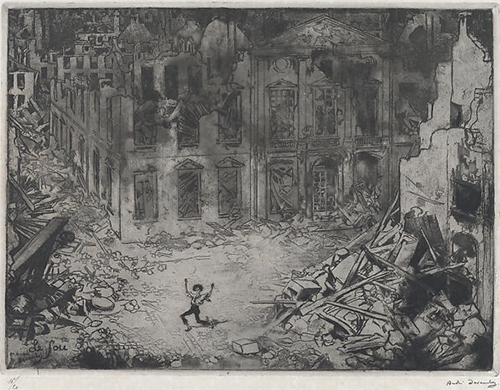
War and Representation is a seminar dedicated to the study of war across literature and other media from the 19th to 21st century, with a particular emphasis on Russophone contexts. We will investigate questions of genre and writing practices, authorship and readership, and historical and social interventions through literature and other media by examining canonical and non-canonical works from a range of artistic traditions. Reading books, watching films, and playing the occasional game, we pose several questions: how has art represented and justified war? How has it resisted and critiqued it? How are concepts of nation and ideology understood through war texts? In what ways do contemporaneous and retrospective depictions of war differ from one another? How does form (books, films, games) affect how war narratives are conveyed? While the course’s main emphasis is on Russophone art, the course’s materials originate from myriad cultures and artistic traditions, including Russian, Ukrainian, Jewish, Belarusian, American, German, and Italian. The course’s texts will span a variety of mediums, and include novels, short stories, film, poetry, oral testimony, video games, and photography. Through the close reading of a variety of texts, we will explore the ways in which war is not only represented in literature and other media, but how it is repackaged as art fit for popular consumption. We will seek to understand the place of war in arts and cultures, and its role in (re)producing both histories and mythologies. All readings and discussions will be conducted in English.