

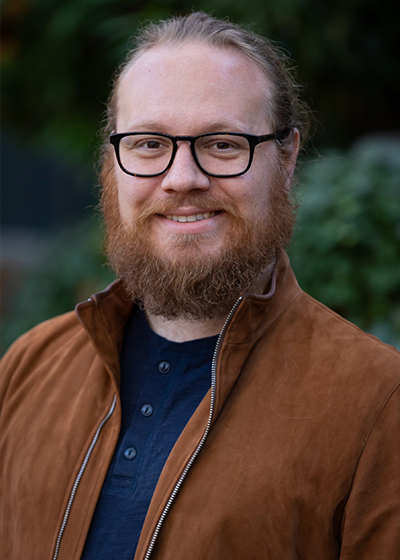
Chris Halsted is a historian of early medieval Europe, focusing on borders, boundaries, and the creation of ethnic identity in the ninth and tenth centuries. His research explores subjects including connectivity and trade in eastern Europe and Eurasia, witchcraft, and the intersecting construction of gender and ethnicity. His work has been published in venues including Viator, Early Medieval Europe, and Medium Ævum, and is forthcoming in Speculum and The Haskins Society Journal. He has received support from the University of Virginia’s Jefferson Scholars Foundation, the Gerda Henkel Stiftung, the Kluge Center at the Library of Congress, and Yale’s Gilder Lehrman Center for the Study of Slavery, Resistance, and Abolition. His first book, The Silver Age: Globality, Society, and the Slave Trade among the Baltic Slavs, 750-1050, is currently in process.
Chris Halsted
Andrew W. Mellon Postdoctoral Fellow in the Humanities
2025—2026 Forum on Truth
Chris Halsted
History
University of Virginia, 2021
Imagining a World Gone Wrong: Truth, Identity, and Fear in Early Medieval Europe
“Imagining a World Gone Wrong” focuses on the reaction of early medieval Christian thinkers to the transformations of the sixth and seventh centuries. Early medieval thinkers circulated a number of blatant untruths during these turbulent centuries. Many of the thinkers behind these untruths knew them to be incorrect: Maximus the Confessor, an influential Byzantine theologian, lamented after the Islamic conquests “to see our civilization laid waste by wild and untamed beasts who have merely the shape of a human form” — even though he had personal experience with Muslims and had possibly collaborated with them during the conquest of Egypt. The anonymous Mozarabic Chronicle of 754, despite a generally favorable depiction of Muslims by an author who seemingly lived and worked within the Andalusī court, described the conquerors of Spain as butchering and razing Christian cities, executing infants, and founding a “savage kingdom” on the ruins. My project focuses on the function that these untruths had within their contexts: what did medieval Christian thinkers mean when they disseminated these falsehoods? How did they use these ideas to make political or religious arguments, or to further their own careers? And how did these ideas contribute to the wider development of European and Christian identity during this time?