


Sergio Emilio Carballido is a final-year student passionate about the intersection of the humanities and social sciences, particularly where religion and economics meet, and how people find meaning through things, ideas and people. With a deep curiosity about culture and human behavior, he brings an open mind and a thoughtful ear to every conversation. Feel free to reach out! He’s always happy to connect, especially if there's coffee around.
Sergio Emilio Carballido Murcio
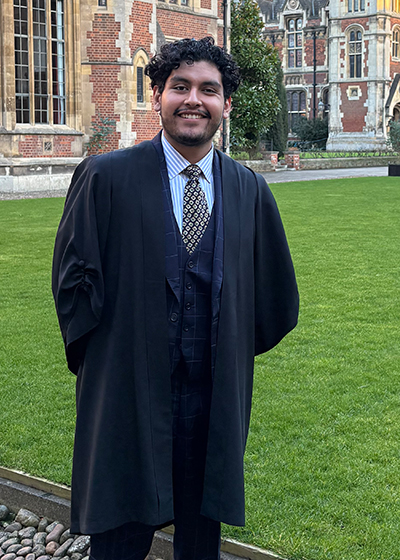
Wolf Humanities Center Undergraduate Fellow
2025—2026 Forum on Truth
Sergio Emilio Carballido Murcio
Executive Board, Wolf Undergraduate Humanities Forum
Religious Studies, Mathematical Economics
CAS, 2026
Accessing Truth Through Mind: A Comparative Study of Ratnakīrti’s Epistemology and Nāgārjuna’s Mādhyamaka
Following a tradition that can be traced at least from Descartes, western philosophy has assumed the subject-object duality, questioning constantly the interactions and characteristics of both notions. Can the subject access reality? Descartes conceptualized the mind (the thinking “I”) as fundamentally distinct from external reality. Heidegger, in a revolutionary approach, takes the being of the subject (Dasein) to be intimately intertwined with the world—however, he still preserves a meaningful, if more fluid, distinction between Dasein (the subject) and the objects it encounters. On the other hand, Buddhist philosophers have taken a more radical approach. Ratnakīrti’s emphasis on the mind’s conceptual constructs and Nāgārjuna’s insistence that nothing has an independent essence both challenge the classical subject–object duality even questioning the existence of reality. This paper dissects Ratnakīrti’s and Nāgārjuna’s arguments to challenge the notion that our mind can access truth.