


Christine Woody is Associate Professor of English and Director of the Textual Scholarship Certificate Program at Widener University. She works on the literature and publishing culture of nineteenth-century Britain, with a particular interest in dynamics like serialization, anonymous/pseudonymous publication, and the professionalization and commodification of authorship. Her work has been published in Studies in Romanticism, Victorian Periodicals Review, Essays in Romanticism, and the Keats-Shelley Journal, as well as in several edited collections. She is working on her first book.
Christine Woody
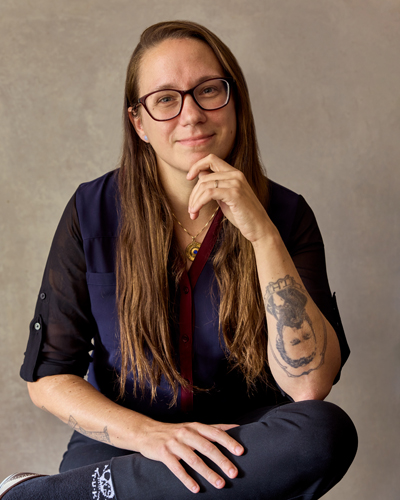
Wolf Humanities Center Regional Fellow
2025—2026 Forum on Truth
Christine Woody
Associate Professor, Department of English and Creative Writing, Widener University
Publishing Personality: Romantic Periodicals and the Paradox of Living Authorship
This project intervenes around the question of how, historically, people have thought about themselves as understanding the truth of their own contemporary moment. In particular, it will focus on how the periodical functions as a mass medium in early-nineteenth century Britain: a medium that allowed for a national-scale audience for debates, interpretations, and literary works. In this period, publication in periodical reviews, magazines, and newspapers was systematically anonymous and pseudonymous, and thus it provides a fascinating laboratory for thinking about how people make and authenticate truth claims across named individuals, institutions, and unstable pseudonymous avatars. In this era, periodical media variously frame themselves as engaged in truth projects—projects of dissemination (this is particularly tense during the Napoleonic wars and the post-Waterloo social unrest), negotiation (book reviews were a dominant site of contestation over meaning and interpretation), and construction (the mass appeal of periodical as a publication site for imaginative literature begins now).
The project is particularly focused on how this need to disseminate, stabilize, or create truth coheres around the figure of the author. Periodicals increasingly uncover, mobilize, or invent the authorial body as a way to guarantee and settle questions of truth. It is through this lens that it will describe and interpret an increasingly combative and personal book reviewing culture that often reduces books to their author’s foibles: personal truths serve as synecdoches for the meaning of claims about the world and society published in books and pamphlets. Meanwhile, periodical authors embroider their own truths onto this media environment: in the post-Waterloo years, increasingly creative and performative uses of periodical literature give rise to what at times feels like a pre-digital post-truth moment, with counterfactual claims and spurious performances receiving an increasingly enthusiastic reception from the reading public.