


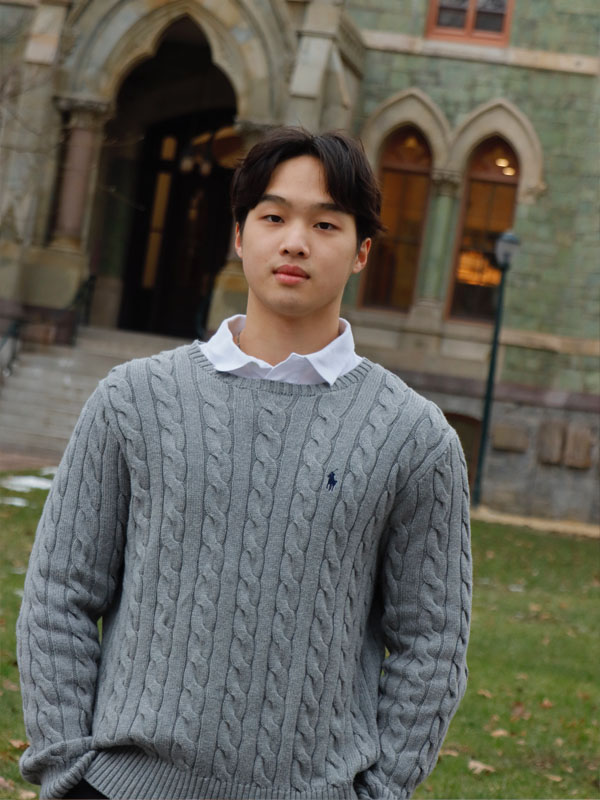
Charles Shen is a fourth-year student majoring in World History and Neuroscience and minoring in Chemistry. Born in the Bay Area and raised in Shanghai, China, he is interested in the intersection of history, health, and human experience. At Penn, Charles has explored these interests through neuroscience research on Parkinson’s disease and songbirds, clinical research in emergency medicine, and EMS work with a 911 ambulance agency. Through the Wolf Humanities Fellowship, he hopes to examine the medical innovations of the Korean War from a microhistorical perspective through the lens of one surgeon’s experience, offering a more human, ground-level view. Outside of academics, Charles enjoys film photography, playing guitar, lion dancing, and learning from the people and stories around him. He loves meeting new people and is always happy to connect.
Charles Shen
Wolf Humanities Center Undergraduate Fellow
2026—2027 Forum on Practice
Charles Shen
History, Neuroscience
Through the Lens of a Korean War MASH Surgeon: Dr. Melvin Horwitz and the Real-Time Practice of Medical Innovation
The Korean War functioned as a laboratory for medical innovation, as Mobile Army Surgical Hospitals (MASH) pushed advanced care to the front lines and enabled numerous clinical advancements. While existing narratives often rely on retrospective memoirs or fictional stories, this project seeks to challenge that teleological perspective by examining the real-time experiences of MASH surgeon Dr. Melvin Horwitz. Using his unedited wartime correspondence, I will reconstruct his day-to-day clinical practice under pressure, capturing the uncertainty and immediacy of care. This microhistorical approach connects Horwitz’s immediate actions (such as performing limb-saving arterial repairs) and observations to broader historical questions. How did clinical innovation evolve in stabilized late-war units? How did military practices translate back to postwar civilian medicine? Drawing on archival materials and contemporary medical literature, this project aims to move beyond the clinical gaze by reuniting clinical practice with human reflection, offering a more nuanced, human-centered account of wartime medicine.